


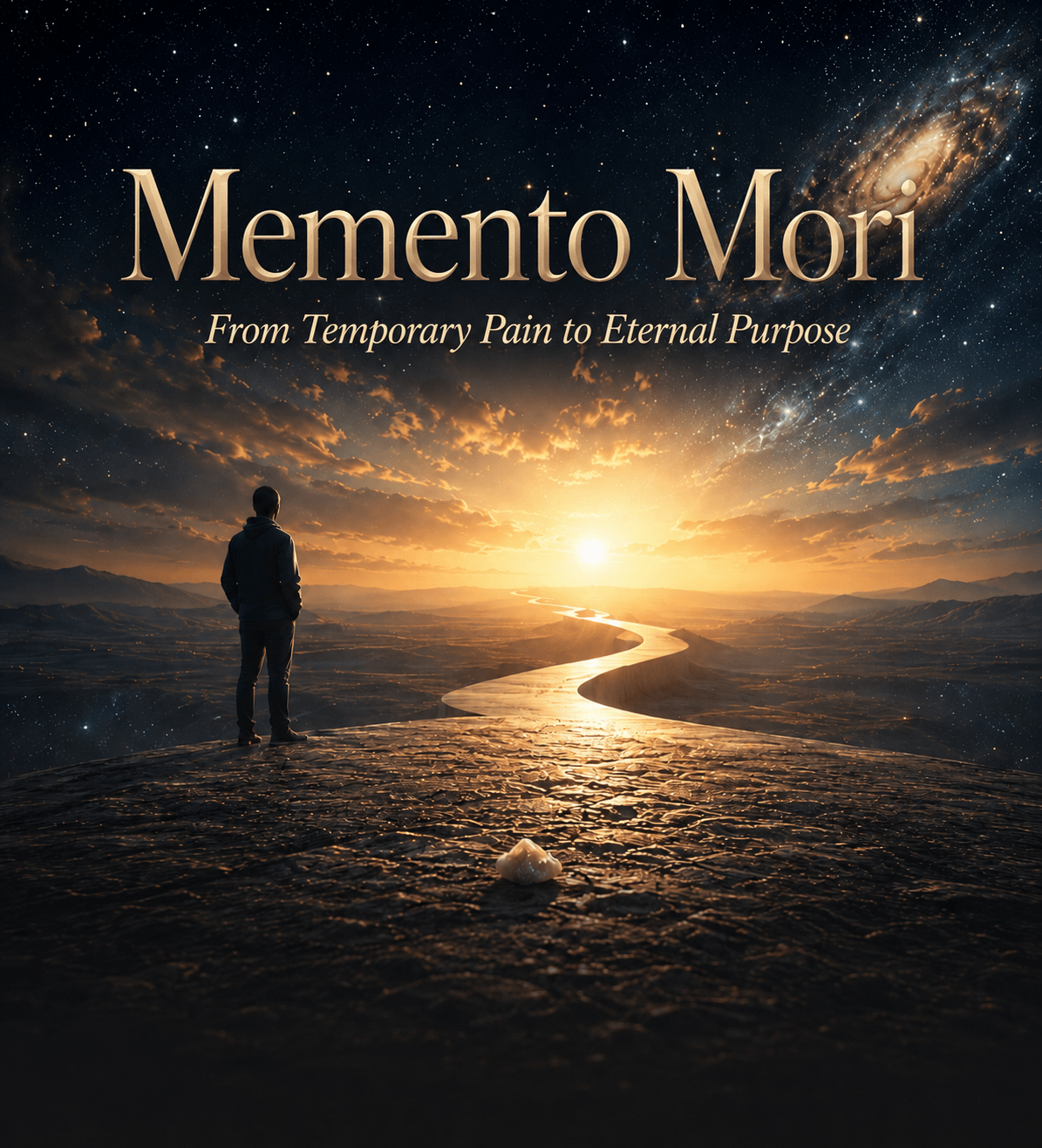
Memento Mori: From Temporary Pain to Eternal Purpose
Jose Marrero
“Memento mori” is a Latin phrase meaning “remember that you will die.” For centuries, it served as a warning against wasting life on temporary things and as a call to live with wisdom, purpose, and eternity in mind.
Imagine a path stretching through galaxies, past every known planet, and far into the reaches of human imagination—a path with no horizon and no end. It continues through the endless expanse where space and time seem to dissolve, running forever into eternity.
Now place a single grain of salt at the very beginning of that endless path. Look at it closely. It is tiny, fragile, and almost invisible. Then compare that grain to the immeasurable distance of the never-ending path stretching before it. Can they truly be compared? Of course not. The grain disappears against infinity. It is not merely small; it is nearly imperceptible.
That grain of salt represents one hundred years. It symbolizes the longest lifespan many people hope to live. It feels long to us. We build dreams inside it. We chase money, success, pleasure, and status. We worry, struggle, and lose sleep over things that will eventually fade away. We fear losing things that were never ours to keep.
Yet when compared to eternity, even a hundred years is less than a whisper in a storm. Every possession, triumph, and title is but a fleeting vapor against the endless ocean of eternity. So why do we chase the least important priorities at the expense of what will matter in the end?
Are You Chasing What Will Matter Most?
Pause for a moment and consider your highest priorities. What occupies your thoughts, consumes your energy, and claims your time? Are you focused primarily on what is important and enduring, or on what is urgent—the endless demands, emails, texts, calls, and deadlines?
Now imagine you have just one hour left to live. That’s it. Just one hour. Suddenly, your priorities shift completely. Wouldn’t they?
The ancient Roman warning of memento mori was never intended to produce fear or hopelessness, but clarity: life is short and should not be squandered on things that fade, decay, and ultimately disappear. Things that once seemed urgent and indispensable would no longer capture your attention. They would seem like dust carried away by the wind. Titles, money, popularity, unfinished tasks, financial pursuits, emails, and other daily worries would fade into the background.
In omnibus respice finem. “In all things, look to the end.”
— Attributed to Thomas Aquinas
In the end, what would matter most? Would you be ready to stand before our Creator? Would your soul rest assured, knowing the precious gift of your life was spent on what truly mattered?
Pause and Reflect
“In 100 years, our bodies will be buried with our families and friends. Strangers will live in our homes that we worked so hard to build and someone else will own everything we have today. Most of our possessions will be given away, thrown out, or destroyed, including that truck or car that we spent a fortune on. Our descendants will hardly know who we were, nor will they remember us. How many of us know who our grandfather’s father was? After we die, we will be remembered for a few more years and then we’re just a portrait on someone’s wall. If we pause one day to analyze our lives, perhaps we would understand how pointless it is for us to worry about 95% of the things that consume our minds daily. With that understanding, we may choose to invest more of our time in what is lasting — faith, virtue, relationships, service, and the good we leave behind in the lives of others.”
— Anonymous
That reality was described nearly 2,900 years ago in Ecclesiastes 1:2: “Vanity of vanities; all is vanity.” It is a sober reminder that human ambition is often little more than dust in royal attire. The mansions we idolize, the titles we pursue, and the popularity or acceptance we seek with sleepless anxiety are all vanities that will carry no weight in our final moments unless they have been used in service to the Creator and for the good of others.
“Only a life lived for others is a life worthwhile.”
— Attributed to Albert Einstein
Sic transit gloria mundi
“Thus passes the glory of the world.”
Every empire, achievement, possession, and human applause eventually dissolves into silence. Then, when we are granted only a final brief moment, we may awaken to the dreadful realization that we have lived at the center of the greatest tragedy of all: spending a lifetime chasing the wind and wasting the sacred gift of life on things that have vanished, or worse, on things that made us emotionally and spiritually enslaved because we allowed them to do so.
We Are Often Our Worst Enemies
Can we see that much of what consumes us is not only temporary but, in many cases, harmful? We spend enormous amounts of time chasing what is perishable, entertaining darkness, indulging our appetites, and enslaving ourselves to our vices and impulses.
Who is in charge? Us or our vices? Are we spending years constructing our own prisons while calling them freedom? Are we on the path to eternal suffering?
Let’s face it. If we fail to reach the place of “perfect happiness” and instead arrive at the place of eternal suffering, we will have become the most tragic figures imaginable. Eternal suffering is exactly that: unending suffering far beyond anything we have ever experienced or could possibly comprehend. Would it not, then, make sense to make the pursuit of eternal happiness beyond this short life the central purpose of our existence? This is more than a question; it is an answer.
Conversely, the joys of eternal happiness are indescribable, fully experienced in a “perfect now.” Every wound carried on earth — abuse, betrayal, disappointment, PTSD, tribulations, injustices, and emotional scars — will be healed, restored, and remembered no more. Ponder that truth and let it sink into your heart.1
1 Thomas Aquinas, the greatest intellectual giant of his age and the brilliant mind behind the Summa Theologica, caught a glimpse of Heaven. It silenced him. The man whose writings shaped centuries of thought never finished one of the greatest works ever written, declaring that all he had produced was merely “straw” compared to what he had seen. If that was his reaction, what awaits beyond this world?
Non nobis solum nati sumus
“We are not born for ourselves alone.”
That phrase, from Marcus Tullius Cicero, goes beyond our personal desires; it is a calling.2 Everything we do for the Divine Designer and for others is an investment in eternity. Such investments extend far beyond this life. They matter greatly: the lives we change for the better, the faith we promote, the love and service we give, and the purpose we fulfill.
2 Source: Cicero’s foundational work on ethics, De Officiis (On Duties), written in 44 B.C.
How much of what you are building today will endure beyond this life? It is easy to get “caught in mental knots” managing the immediate while ignoring the eternal. A meaningful life is not measured merely by productivity, possessions, or applause. It is also measured by what outlives us. The real test, then, is translating eternal truths into daily choices.
Insight without reflection becomes mere entertainment. Thus, before moving forward, confront yourself:
Pause and Examine Yourself
Questions Worth Asking
- Is the choice I am just about to make aligned with my purpose in life, or is it merely a reaction to the heat of the moment?
- Am I focusing on what truly matters for my family, or am I falling into the trap of culture or peer pressure?
- Am I following the compass of my purpose, or am I seeking the admiration of others?
You will always have people who admire you and others who despise you. Does it matter? Do not allow the changing opinions of people to determine the unchanging value of your life. People’s judgments rise and fall like the wind, but your purpose remains. Seek truth, live with courage, and remember that your worth is not measured by human approval but by the purpose for which you were created.
Count your blessings. Do not compare yourself to others. Comparison steals gratitude, distracts your focus, and weakens your sense of identity by measuring your worth against someone else’s journey. Your only true rival is the person you were yesterday; strive each day to grow in character, purpose, and faith, and set your soul on fire with the pursuit of becoming the person God created you to be.
- What choice, if made tonight, will I regret tomorrow?
Five minutes of reflection can save you 50 years or even an eternity of pain. Temporary pleasure or permanent pain: the choice is yours.
Think Before You Act
Are you carrying burdens no one sees? A troubled marriage? Humiliation crying out for revenge? Debt? Exhaustion? Fear of future responsibilities and financial instability? An unexpected pregnancy? Other suffocating burdens?
Before a single decision becomes an irreversible negative action, pause. Some choices made in minutes leave scars measured in decades, even lifetimes. Remember this:
- Anger fuels revenge.
- Despair breeds misery.
- Unrestrained appetites lead to betrayal.
- Fear clouds the mind and weakens the spirit.
- Bitterness imprisons the soul and steals peace.
- Resentment keeps old wounds open and prevents healing.
Yet, storms pass. Shame passes. Financial hardship passes. Rejection passes. Even burdens that appear endless eventually loosen their grip. The ancient proverb still whispers across generations: “This too shall pass.”
Temporary suffering should never become a permanent verdict. Before thoughts of revenge become violence, before resentment hardens into hatred, before despair becomes self-destruction, and before impulse becomes crime, ask yourself: Will this choice still seem wise when my negative emotions have faded?
“My third maxim was…to conquer myself rather than fortune…”
— René Descartes, Discourse on Method
Your Story Is Not Finished
If you are contemplating ending your life, please do not carry that battle alone. Reach out immediately to someone who can stand with you—a trusted friend, family member, pastor, counselor, physician, or crisis hotline.
The pain you are experiencing may feel overwhelming, but it is not a reliable predictor of your future. The darkness you feel today does not mean there is no hope for tomorrow.
Your anguish may be profound and exhausting. You may feel trapped, hopeless, or unable to imagine a way forward. Those feelings are real, but they do not define you, and they do not have the final word over your life. A moment of unbearable pain does not have to become a permanent decision. Allow someone to walk beside you, share your burden, and help you through this difficult moment until the storm begins to pass. The pain you feel today does not have to determine the rest of your story. Your life possesses immeasurable worth, and there are chapters yet unwritten that may contain healing, purpose, and blessings you cannot presently imagine. Stay. Reach out. Let others help carry the weight.
God wants to forgive you. Do not assume that He will not. His mercy is far greater than all your faults, sins, failures, and regrets combined.
He still loves you. He has a purpose for your life. Nothing can separate you from the love of God (Romans 8:38–39). He is not giving up on you, so do not give up on Him. Even when you cannot see a way forward, He sees the entire path before you. Hold on. Trust Him. Better days may be closer than you think.
Every Life Is Worth Living
Are you facing a difficult pregnancy? The child growing within you is a life entrusted to your care — flesh of your flesh, carrying a future that neither you nor anyone else can fully see. Motherhood is among the most dignified callings in human existence. Upon the quiet courage of mothers rests the future of families, communities, and generations.
Those burdens should not rest upon the mother alone. A father’s responsibility extends beyond creating life. He is called to protect, provide, remain present in hardship, and share the weight of sacrifice when fear, uncertainty, and responsibility arrive.
At this moment, the circumstances may seem overwhelming, but it is worth remembering that today’s hardship is not always tomorrow’s reality. Many who once stood in the midst of an impossible situation later discovered reasons for gratitude they could not have imagined at the time. Before making a permanent decision in response to a temporary crisis, consider whether there may be another path, one marked by courage, support, and love. In some cases, that path may include the generous gift of adoption, allowing a life to continue while opening the door to hope and joy for others.
Every difficult circumstance raises the same fundamental question: What am I living for? When purpose is unclear, pain often becomes the loudest voice in the room. Nevertheless, when purpose is discovered, it reshapes priorities and gives suffering a context larger than the present moment.
That leads to a more uncomfortable but necessary examination of the heart:
You Have a Purpose: Have You Discovered It Yet?
- You were created for something higher, broader, and more powerful than mere survival. Are you living beneath your design?
- If the way you live today determines where you spend eternity, what should your priorities really be — now, tomorrow, and forever?
- Return to that earlier question: if you had only one hour left to live, what would suddenly matter most?
- Who have you still not forgiven?
- Have you asked for forgiveness — even from a distance, even in silence?
- Have you forgiven yourself, your parents, and the people who wounded you?
- Isn’t it true that life feels lighter when you’re helping someone else instead of obsessing over yourself?
- What owns your heart right now? What should own it?
- Who still needs your love while there’s still time to give it?
- What eternal investment have you been postponing while spending everything on temporary things?
- When do you feel closest to God?
- If your life preached a sermon without words, what message would people hear?
The moment you discover the reason you were created, life stops feeling random. Purpose ignites energy. Meaning fuels endurance. Conviction produces impact.
More importantly, purpose is not meant to remain confined within the individual. The convictions that shape a life eventually shape families, relationships, communities, and organizations.
Purpose creates influence, and influence guides others. Wherever guidance and advice exist, leadership follows. Whether intentionally or unintentionally, every person leads those around them.
Purpose Produces Better Leaders
Leadership does not begin with titles, positions, or authority. It begins with the person in the mirror. Our character, values, and beliefs — or, simply put, who we are — drive our personal leadership (how we lead ourselves), and our personal leadership shapes our professional leadership (how we lead others). Our professional leadership style reflects how we think and feel deep inside. These realities challenge the mistaken assumption that leadership is primarily about what we do to others rather than who we are.
Leaders perform better when their actions are connected to a larger framework of meaning, responsibility, and inspiration. When our purpose at work aligns with our purpose at home and in life, our energy becomes renewable, our motivation deepens, and our goals stop feeling temporary. We become relentless, not because life becomes easier, but because “our why” becomes stronger than our excuses, distractions, or fears.
The rewards that come from discovering and pursuing our purpose do far more than improve us as individuals. They refine our character, strengthen our influence, and elevate our ability to lead others.
Are these benefits powerful? Absolutely. Some are even transformational. Purpose does not remain confined to the heart. It expresses itself through habits, discipline, and relationships. A strong purpose reshapes an individual’s mindset, emotions, character, and behavior. In leadership, formal or informal, the impact becomes even more pronounced, particularly when work purpose is aligned with life purpose. Consider the following.
One Purpose But Multiple Advantages
In leadership, personal purpose is not private motivation; it becomes the internal architecture of how a leader serves, decides, and influences others. The following dimensions show how purpose forms the character and capacity of a servant leader.
Direction: Purpose is your internal compass. It provides clarity to prioritize people over noise and mission over ego. Purpose guides priorities, relationships, and daily habits so you stop drifting through life without intention. Leaders with direction inspire confidence because people tend to trust those who know where they are going.
Motivation: When your actions are connected to something meaningful, you gain deeper energy, persistence, and drive. Purpose helps you keep moving even during difficult seasons. Purpose-driven leaders sustain momentum and inspire others to persevere. Purpose enables leaders to serve consistently, even when recognition is absent.
Discipline: Purpose increases focus and self-control because you become more protective of your time, habits, energy, and attention. A clear mission defeats distractions. Strong leadership often depends less on talent and more on disciplined consistency.
Resilience: A clear why strengthens emotional endurance and helps overcome setbacks, disappointment, hardship, and failure. Resilient leaders remain steady when others become discouraged.
Hope: Authentic leaders are hope restorers. Even in painful seasons, purpose reminds you that your life still carries meaning. It sustains perseverance. Great leaders breathe hope into uncertainty, and people inspired by hope will endure the darkest valleys and follow them to the ends of the earth.
Fulfillment: Achievement without purpose can still feel empty, but purpose produces deeper satisfaction because you know your life contributes to something much larger than yourself. Fulfilled leaders often lead from service rather than ego.
Mental Health: Mentally healthy leaders build mentally healthy teams. Clinical psychologists and mental health researchers consistently find that a clear sense of purpose acts as a protective factor for mental health. Leaders with psychological stability are better equipped to make sound decisions, endure pressure, and support others.
Research suggests that purpose can buffer psychological distress and strengthen overall well-being. People with a stronger sense of purpose tend to report lower depression and anxiety, greater resilience during stress, higher life satisfaction, and healthier coping mechanisms.
One meta-analysis involving more than 66,000 participants found that a stronger sense of purpose in life was significantly associated with lower levels of depression and anxiety across diverse populations.3 Additional research suggests that purpose in life may be linked to adaptive motivational processes, resilience, and psychological well-being.
3 Boreham, I. D., & Schutte, N. S. (2023). The relationship between purpose in life and depression and anxiety: A meta-analysis. Journal of Clinical Psychology, 79(12), 2736–2767. https://doi.org/10.1002/jclp.23576
Taken together, the evidence suggests that purpose does more than improve well-being; it strengthens the very qualities required to endure, influence, and lead.
This reality becomes most powerful when applied to the lived experience of someone standing in uncertainty, regret, or struggle. This raises a key question: What happens if we let go of the past, rise above what is afflicting us, and begin to live our purpose?
It Is Not Too Late
You may be going through a valley of despair thinking that it is too late to seek your purpose and follow it. Remember, you are not going into the valley to stay; you are going through it.
Are you haunted by the past? Haunted by failures, fears, and falls? Failure may describe an event; it should not define a person. You can learn from your mistakes, apply the lessons, and move forward.
You may feel fear, but fear of what? Fear of starting too late? Fear of being judged? Fear of disappointing others? Of failing again? Courage is not the absence of fear. Courage is moving forward despite the challenges. Every meaningful life requires stepping into uncertainty.
The greatest tragedy is rarely failure; it is reaching the end and realizing fear made your decisions for you. Many people do not lose their purpose because they lacked ability; they lose it because fear convinced them not to begin.
Do not let fear become the architect of your future, building walls around the life you were meant to live. Our Creator is greater, bolder, and stronger than all our problems combined — infinitely greater than addiction, depression, painful memories, losses, failures, and fears. Believe. Drown your fears in faith, and you may discover that what once threatened to bury you becomes the very ground where hope begins to grow.
You may feel broken, defeated, anxious, or caught in the grip of despair. You may have fought your battles for so long that you no longer have the strength to continue alone. You may simply be weary. Pause and reflect on these words of hope:
“Come to me, all you who are weary and burdened, and I will give you rest.”
— Matthew 11:28
Trust Him. Cast your burdens, fears, afflictions, failures, and worries upon Him. He is not merely a source of comfort; He is a source of victory:
- When your strength fails, His does not.
- When your vision is clouded by fear, He sees clearly.
- When your heart is wounded, He brings healing.
- When the battle is too great for you, He fights on your behalf.
He restores the broken, strengthens the weary, lifts the fallen, and gives new life to those who seek Him. No burden is too heavy, no failure too great, and no darkness too deep for His power to overcome.
You have fallen. Learn from your experiences and apply the many lessons. Release bitterness. Never quit. Never surrender hope. A new day comes, bringing new hope, new beginnings, and new life.
Your Past Pains Are Not in Vain
You may believe your story has become too broken, too painful, or too empty to matter anymore. But what if the very fact that you are still here means your purpose has not expired? What if all the suffering and pain you have endured are the very tools that will help you guide others?
You have gone through painful and even devastating experiences, but the rest of your life will not unfold with the same darkness. Your past experiences have not been a waste. They have forged endurance, compassion, and wisdom. The world can use people who have suffered, survived, and become a light for others standing in the same valley. Do not mistake suffering for a worthless life. It is the opposite.
God loves the brokenhearted and has not forgotten you. If you are carrying burdens that seem unbearable, remember that your value is not determined by your pain, failures, or present circumstances. Even in your darkest moments, you remain a person of immeasurable worth. Your life matters more than you know.
Your wounds may become lessons that will help someone else thrive and restore hope. The life you are tempted to surrender today still carries eternal meaning and unfinished assignments. There are people you have not yet lifted, loved, or led. You may not know them now, but if you put your potential to work, you will meet them. You are, or can become, a giver. You possess immense value.
Your suffering has revealed value and strength you did not recognize before. Stay long enough to discover what the Divine Designer still intends to do through you.
The enemy of purpose is not suffering; it is surrender. History is filled with ordinary people who transformed pain into service and brokenness into strength. Do not quit before discovering who you are capable of becoming and what you are capable of giving.
When Your Calendar Closes
One day, every calendar will close, every title will fade, and the applause will cease. The clock is already ticking. So, stop living distracted, divided, and spiritually asleep.
You have a purpose – find it! Love, forgive, and serve. Walk energized and inspired by your why. Build a life anchored in truth, faith, and meaning.
Make an investment that will yield forever. Then get up, find your true north, and move toward it with conviction.
Be a spirit lifter.
Be a hope restorer.
Be a heart healer.
Eternity is not approaching someday; you are already walking toward it.
References
1 Thomas Aquinas, the greatest intellectual giant of his age and the brilliant mind behind the Summa Theologica, caught a glimpse of Heaven. It silenced him. The man whose writings shaped centuries of thought never finished one of the greatest works ever written, declaring that all he had produced was merely “straw” compared to what he had seen. If that was his reaction, what awaits beyond this world?
2 Source: Cicero’s foundational work on ethics, De Officiis (On Duties), written in 44 B.C.
3 Boreham, I. D., & Schutte, N. S. (2023). The relationship between purpose in life and depression and anxiety: A meta-analysis. Journal of Clinical Psychology, 79(12), 2736–2767. https://doi.org/10.1002/jclp.23576
About the Author
Jose M. Marrero has served as a professor, motivational speaker, director, and senior U.S. Army officer. He has held senior leadership and strategic positions in the United States and abroad. Jose has also served as a coach and trusted advisor to executives, managers, political appointees, and other professionals throughout his career. He has taught numerous customized seminars for local, state, and international organizations, including Fortune 500 companies.
During his nearly five decades of experience, he held numerous assignments, including:
- Teaching at the United States Military Academy, West Point, NY
- Commander at various levels
- Strategist at the Strategy, Policy, and War Plans Division, the Pentagon
- Operations Officer at various levels
- Chief of Staff
- Military Advisor to a U.S. Ambassador
- Senior Analyst at the White House ONDCP, Washington, D.C. — among other regular and special assignments.
Above all, Jose has proudly led Soldiers to perform meritoriously under uniquely difficult and challenging conditions. He has spearheaded various international negotiation efforts, culminating in agreements with foreign governments. In addition to drafting strategies, he has formulated and implemented strategic communication plans, and has prepared speeches and presentations for Executive Officials, General Officers, and Political Appointees.
He has authored over 23 articles. In addition, Jose is among the very few who have been awarded the Presidential Service Badge for his service at the White House ONDCP.
Jose has been an avid athlete for most of his life. In addition to playing several sports, he taught martial arts, competed in boxing and wrestling, and completed three triathlons. He is a member of the International Foreign Language Honor Society (Phi Sigma Iota) and earned his postgraduate degree from Vanderbilt University.
Image Source: ChatGPT
Quote of the Day
“The key to successful leadership today is influence, not authority.”
— Kenneth Blanchard