


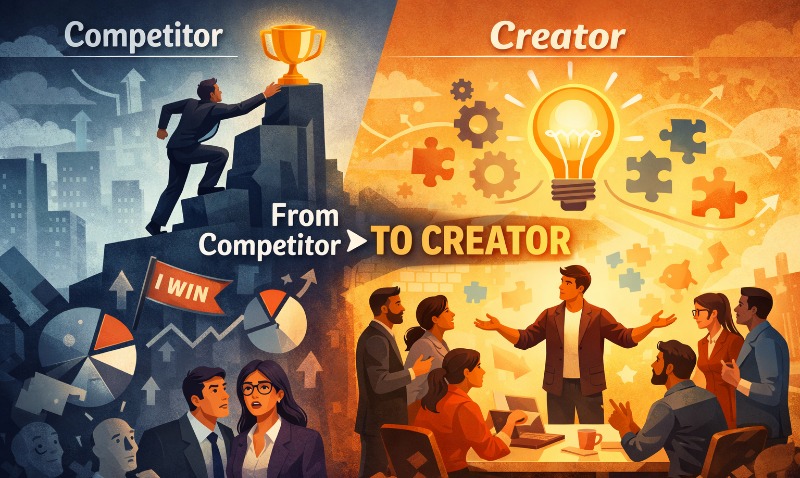
From Competitor to Creator
Grant Wyatt
Win. Outperform. Stand out. Be better than the person next to you. It sounds like ambition, but often it’s insecurity dressed up as drive.
If your success depends on beating others, you’ve set a ceiling on your potential. The highest performers aren’t obsessed with competing; they’re obsessed with creating.
Competition Is a Scarcity Strategy
Competition assumes a fixed pie – one promotion, one seat at the table, one “top performer” slot. When you buy into this mindset, you begin to optimise for visibility over value.
Information is hoarded, credit is protected, and subtly people position themselves ahead of others rather than alongside them. It might deliver short-term wins, but it extracts a long-term price:
Trust erodes: Collaboration becomes a performance, not a genuine practice.
Energy is wasted: You spend more time managing perception than solving real problems.
Success becomes fragile: Your standing depends on staying ahead of others, not on expanding your actual capability.
The real risk isn’t losing to your peers. It’s becoming someone no one wants to win with.
From Extraction to Generation
Creators play an entirely different game.
The highest performers aren’t obsessed with competing; they’re obsessed with creating. While a competitor asks, “How do I stand out?” a creator asks, “What hasn’t been thought of and how can we build it?”. This shift moves you from extracting value to generating it.
When you operate as a creator, collaboration becomes natural because ideas are sharpened by diverse perspectives rather than protected by egos. Guarding your position gives way to thinking broadly and taking the kind of smart risks that reveal true potential.
Competitor to Creator
At senior levels, individual brilliance is rarely the deciding factor. What matters is what you unlock in others, the problems you help solve across teams, and the outcomes you enable beyond your own remit.
The leaders who build lasting impact treat others’ achievements as force multipliers, not as threats. Skills plateau, but influence and trust compound without limit. Every meaningful outcome in business is delivered through people.
The ego wants validation. It wants to be right. It wants to be the smartest person in the room. That’s the small game.
To raise your ceiling, adopt behaviours that expand the collective:
Share credit generously. Hoarding recognition signals insecurity. Sharing it builds networks invested in success together.
Bring people in early. Stop waiting until your idea is polished. Invite others into the messy formation stage – this is where innovation and alignment begin.
Listen with intent. Most people listen to reply. Listen to understand. Understanding someone deeply gives you access to perspectives that would otherwise stay invisible.
Make the room smarter. Don’t aim to be the smartest person in it. Be the one who makes the room smarter, that’s the difference between visibility and value.
The Bigger Game
If your strategy is merely to outshine everyone else, you’re playing a small, limited game. Operating from a creation mindset rewires your professional worth. You become an integral connector of people, ideas, and execution.
The people who truly shape industries aren’t the ones who win the most; they’re the ones who make winning bigger for everyone.
_____________________________________________________________________
Grant Wyatt is a Melbourne-based HR executive, author, and keynote speaker focused on responsibility-centred leadership, workplace culture, AI, and the future of work. You can find him on LinkedIn here.
Image Source: ChatGPT
Quote of the Day
“The key to successful leadership today is influence, not authority.”
— Kenneth Blanchard